Consider This with Eli Saslow
Join Oregon Humanities for a conversation about poverty and addiction in America with Eli Saslow. Eli Saslow is a national reporter for the New York Times. His recent reporting has focused on homelessness, inequality, and opioid addiction in Arizona, California, and Oklahoma. He lives in Portland. This conversation will explore how intersecting crises of housing, drug addiction, and mental health affect people and communities across the country. We’ll also discuss the stories we tell about these crises. From what perspectives are they told? And who are they for? General AdmissionPrice: $15 Conversation StarterPrice: $30 Ticket sales do not cover the full cost of presenting Consider This events. When you buy a Conversation Starter ticket, you help us keep ticket prices low for everyone. Oregon Humanities uses income from Consider This ticket sales to pay for venue rental and honoraria for our guests. Conversation Starter tickets convey no special benefits beyond good feelings and our gratitude. No Cost To make sure as many people as possible who want to attend are able to, we make a portion of tickets available at no cost. (More information below) If you’re able to pay for a ticket, we ask that you do so to help keep this program accessible to all. Please click the link below to register for no-cost tickets. Click here to register for no-cost tickets to Consider This. About Our Guest In his Pulitzer Prize-winning reporting, Eli Saslow, who has been called “one of the great young journalists in America,” reveals the human stories behind the most divisive issues of our time. From racism and poverty to addiction and school shootings, his work uncovers the manifold impacts of major national issues on individuals and families. Saslow has twice won the Pulitzer Prize: first in 2014 for Explanatory Reporting for a yearlong series about America’s food stamp program for the Washington Post, later collected into the book American Hunger; and in 2023 for Features for his coverage of people struggling with the pandemic, homelessness, addiction and inequality.
CONSIDER THIS with Vanessa Veselka
Oregon Humanities presents a conversation about class, power, and labor with Vanessa Veselka. Vanessa Veselka has been, at various times, a teenage runaway, a sex-worker, a musician, a student of paleontology, a union organizer, a cab driver, and a mother. She is the author of the novel The Great Offshore Grounds, which won the Oregon Book Award for fiction in 2021, and Zazen, which was awarded the 2012 PEN/Bingham Prize for debut fiction. Her short fiction appears in Zyzzyva and Tin House Magazine, and her essays appear in the New York Times, GQ, the Atlantic, Bitch Magazine, and Best American Essays. This program is part of the 2023–24 Consider This series, People, Place, and Power. General AdmissionPrice: $15 Conversation StarterPrice: $30 Ticket sales do not cover the full cost of presenting Consider This events. When you buy a Conversation Starter ticket, you help us keep ticket prices low for everyone. Conversation Starter tickets convey no special benefits beyond good feelings and our gratitude. No CostTo make sure as many people as possible who want to attend are able to, some tickets are available at no cost. (More information below) If you’re able to pay for a ticket, we ask that you do so to help keep this program accessible to all. Click here to register for no-cost tickets to Consider This. Minors ok when accompanied by a parent or guardianReview our Health & Safety Policies HERE
CONSIDER THIS with Mónica Guzmán
Join Oregon Humanities for an onstage conversation with Mónica Guzmán, author of I Never Thought of It That Way: How to Have Fearlessly Curious Conversations in Dangerously Divided Times. Guzmán is a bridge builder, journalist, and author who works to get people to talk across thier perceived divides. She will be joined by Adam Davis, executive director of Oregon Humanities.Tickets: General AdmissionPrice: $15 Conversation StarterPrice: $30 Ticket sales do not cover the full cost of presenting Consider This events. When you buy a Conversation Starter ticket, you help us keep ticket prices low for everyone. Oregon Humanities uses income from Consider This ticket sales to pay for venue rental and honoraria for our guests. Conversation Starter tickets convey no special benefits beyond good feelings and our gratitude. No Cost To make sure as many people as possible who want to attend are able to, we make a portion of tickets available at no cost. (More information below) If you’re able to pay for a ticket, we ask that you do so to help keep this program accessible to all. Please click the link below to register for no-cost tickets. Click here to register for no-cost tickets to Consider This. About Our Guest Mónica Guzmán is a bridge builder, journalist, and author who lives for great conversations sparked by curious questions. She’s Senior Fellow for Public Practice at Braver Angels, a nonprofit working to depolarize America, host of Crosscut’s interview series Civic Cocktail, and author of I Never Thought of It That Way: How to Have Fearlessly Curious Conversations in Dangerously Divided Times. Guzmán was a 2019 fellow at the Henry M. Jackson Foundation, where she studied social and political division, and a 2016 fellow at the Nieman Foundation for Journalism at Harvard University, where she studied how journalists can better meet the needs of a participatory public. Before committing to the project of helping people understand each other across the political divide, Mónica cofounded the award-winning Seattle newsletter The Evergrey and led a national network of groundbreaking local newsletters as VP of Local for WhereBy.Us. A Mexican immigrant, Latina, and dual US/Mexico citizen, she lives in Seattle with her husband and two kids and is the proud liberal daughter of conservative parents.
CONSIDER THIS: Redrawing Borders
Join Oregon Humanities for an onstage conversation on borders and divides. Why are our borders in the places they are, and when should they be redrawn? When are borders useful, and when are they symbolic? Should borders be based on geography, history, culture, or some other criteria? Confirmed guests for this event are Matt McCaw, spokesperson for the Greater Idaho movement, and Carina Miller, chair of the Columbia River Gorge Commission and a research analyst with Warm Springs Community Action Team. General AdmissionPrice: $15 Conversation StarterPrice: $30 Ticket sales do not cover the full cost of presenting Consider This events. When you buy a Conversation Starter ticket, you help us keep ticket prices low for everyone. Oregon Humanities uses income from Consider This ticket sales to pay for venue rental and honoraria for our guests. Conversation Starter tickets convey no special benefits beyond good feelings and our gratitude. No Cost To make sure as many people as possible who want to attend are able to, we make a portion of tickets available at no cost. (More information below) If you’re able to pay for a ticket, we ask that you do so to help keep this program accessible to all. Please click the link below to register for no-cost tickets. Click here to register for no-cost tickets to Consider This. About Our Guests Matt McCaw is a born and raised Oregonian who has lived and worked on both sides of the state. He is currently the spokesperson for the Greater Idaho movement and a board member of Move Oregon’s Border. McCaw and his wife are small business owners and foster parents who are raising their family in Powell Butte. Carina Miller is a member of the Confederated Tribes of Warm Springs. She is chair of the Columbia River Gorge Commission, the co-chair for the Affiliated Tribes of Northwest Indians Energy Committee, chair of the Native American Caucus for the Oregon Democrats, and was formerly an Agency district representative on the 27th Tribal Council of Warm Springs. She lives in Warm Springs, Oregon, with her partner and their newborn son.
Consider This with Casey Parks
Join Oregon Humanities for a conversation about family, belonging, and gender with Casey Parks.A longtime reporter for the Oregonian, Casey Parks now covers gender and family issues for the Washington Post, where she has written about abortion access, Texas’ investigation of parents of trans kids, and the long tail of the US military’s “don’t ask, don’t tell” policy. In her 2022 book, Diary of a Misfit, Parks relates her own story of coming out in a rural Louisiana town in 2002 and her efforts to uncover the story of Roy Hudgins, a small-town singer who, like Parks, didn’t conform to the expectations of his community. This conversation—the first in our 2023–2024 Consider This series about fear and belonging—will explore how attitudes about gender affect where people seem to fit in. We’ll also discuss where these attitudes come from and how they might change.This event is part of Oregon Humanities’ series on Fear and Belonging. General AdmissionPrice: $15 Conversation StarterPrice: $30 Ticket sales do not cover the full cost of presenting Consider This events. When you buy a Conversation Starter ticket, you help us keep ticket prices low for everyone. Oregon Humanities uses income from Consider This ticket sales to pay for venue rental and honoraria for our guests. Conversation Starter tickets convey no special benefits beyond good feelings and our gratitude. No Cost To make sure as many people as possible who want to attend are able to, we make a portion of tickets available at no cost. (More information below) If you’re able to pay for a ticket, we ask that you do so to help keep this program accessible to all. Please click the link below to register for no-cost tickets. Click here to register for no-cost tickets to Consider This. About Our GuestCasey Parks is a Washington Post reporter who covers gender and family issues. She spent a decade at the Oregonian, where she wrote about race and LGBTQ+ issues and was a finalist for the Livingston Award. Her articles have appeared in the New York Times Magazine, the New Yorker, Oxford American, ESPN, USA Today, and the Nation. A former Spencer Fellow at Columbia University, Casey was most recently awarded the 2021 J. Anthony Lukas Work-in-Progress Award for her work on Diary of a Misfit. She lives in Portland.
Science On Tap – Making Memories: Using Neuroscience to Enhance Teaching and Learning
How does your brain learn best? As the field of neuroscience uncovers the neural mechanisms of perception and learning, can we begin to bring these findings into the classroom to help improve how students learn? Back by popular demand, this hilarious Science on Tap will discuss the brain’s learning networks, emotional connections and how the visual and motor pathways influence what we process. Join us as Dr. Mark Pitzer demonstrates of how each brain circuit can be recruited by instructors to improve teaching/learning in and out of the classroom and how neuroscience can make learning truly memorable. Mark Pitzer, Ph.D. is a neuroscientist at the University of Portland. For the last 25 years he has worked to better understand diseases of the brain. He has worked on techniques to improve the survival of newly transplanted brain cells as a treatment for Parkinson’s disease and, more recently, conducted experiments using a genetic technique to halt the production of toxic proteins in the brain as a potential treatment for Huntington’s disease. Currently, his lab is conducting experiments designed to identify the neural circuits and neurotransmitters that play a role in the personality changes that affect those who suffer from Huntington’s disease. Mark is also an award-winning teacher that uses the findings from the fields of learning and neuroscience to invoke enduring enthusiasm, curiosity and deep learning in his college students.Tickets:$45.00 SUPPORTER: Premium seating, pint glass, and good feelings for supporting the program$35.00 VIP: Premium seating in the front several rows of the center section$25.00 GENERAL ADMISSION$15.00 STUDENT$15.00 ONLINE (tune into the live stream only) COVID POLICY Vaccine cards required and checked at entry. Masks are recommended (and subject to be required following any County mandate changes). Review our Health & Safety Policies HERE
Science On Tap – The Sounds of Life: How Digital Technology Is Bringing Us Closer to the Worlds of Animals and Plants
Technology often distracts us from nature, but what if it could reconnect us instead? In The Sounds of Life political ecologist Karen Bakker shares fascinating and surprising stories of nonhuman sound, interweaving insights from technological innovation and traditional knowledge. We meet scientists using sound to protect and regenerate endangered species from the Great Barrier Reef to the Arctic and the Amazon. We discover the shocking impacts of noise pollution on both animals and plants. We learn how artificial intelligence can decode nonhuman sounds, and meet the researchers building dictionaries in East African Elephant and Sperm Whalish. Karen Bakker is a Professor at the University of British Columbia and, in 2022/23, Martina S. Horner Distinguished Visiting Professor and Fellow of the Harvard Radcliffe Institute for Advanced Studies. Her Smart Earth project explores the relationship between digital innovation and environmental sustainability, including research at the frontier of digital bioacoustics, featured in her new book The Sounds of Life. Tickets:$45.00 SUPPORTER: Premium seating, pint glass, and good feelings for supporting the program$35.00 VIP: Premium seating in the front rows of center section$25.00 GENERAL ADMISSION$15.00 STUDENT$15.00 ONLINE (tune into the live stream only) COVID POLICY Vaccine cards required and checked at entry. Masks are recommended (and subject to be required following any County mandate changes).Review our Health & Safety Policies HERE
Science On Tap – How’d They Film That? Behind-the-Scenes of Science Communication at OPB
This event will be IN PERSON at the Alberta Rose Theatre and also ONLINE ($15) Scientists often work for decades to unlock the mysteries of our world and make our lives better. But when you’re trying to explain that amazing work to a wider audience, you’re lucky to have about 10 minutes (unless you’re Science on Tap, of course). At this very special Science on Tap, a behind-the-scenes look at how the folks behind the new OPB show “All Science. No Fiction.” communicate science. How do they pull off all the different things they do on camera to try to get you as excited about science in the Pacific Northwest as they are? “All Science. No Fiction.“ uses whimsy, curiosity and fun to place a spotlight on PNW scientists and the work and they’re doing. These stories are about new marvels of technology, cutting edge solutions and inventions and grand ideas that pass the HCTC (Holy Crap That’s Cool!) test. Jes Burns and Brandon Swanson are the production team behind “All Science. No Fiction.” Jes is a science reporter and producer for OPB’s Science & Environment unit. Brandon is a videographer and editor, working on OPB shows like Oregon Field Guide. They’ve worked in some places, won some awards, and really dig scientists and making videos about their work. Tickets:$45.00 SUPPORTER: Premium seating, pint glass, and good feelings for supporting the program$35.00 VIP: Premium seating in the front several rows of the center section$25.00 GENERAL ADMISSION$15.00 STUDENT$15.00 ONLINE (tune into the live stream only) COVID POLICY Vaccine cards required and checked at entry. Masks are recommended (and subject to be required following any County mandate changes). Review our Health & Safety Policies HERE
Science On Tap: How to Talk to a Science Denier
Can we change the minds of science deniers? Encounters with flat earthers, anti-vaxxers, coronavirus truthers, and others.“Climate change is a hoax—and so is coronavirus.” “Vaccines are bad for you.” These days, many of our fellow citizens reject scientific expertise and prefer ideology to facts. They are not merely uninformed—they are misinformed. They cite cherry-picked evidence, rely on fake experts, and believe conspiracy theories.How can we convince such people otherwise? How can we get them to change their minds and accept the facts when they don’t believe in facts? In this Science on Tap, Lee McIntyre shows that anyone can fight back against science deniers, and argues that it’s important to do so. Science denial can kill.Drawing on his own experience—including a visit to a Flat Earth convention—as well as academic research, How to Talk to a Science Denier outlines the common themes of science denialism, present in misinformation campaigns ranging from tobacco companies’ denial in the 1950s that smoking causes lung cancer to today’s anti-vaxxers. He describes attempts to use his persuasive powers as a philosopher to convert Flat Earthers; surprising discussions with coal miners; and conversations with a scientist friend about genetically modified organisms in food. McIntyre offers tools and techniques for communicating the truth and values of science, emphasizing that the most important way to reach science deniers is to talk to them calmly and respectfully—to put ourselves out there, to meet them face to face.Lee McIntyre is a Research Fellow at the Center for Philosophy and History of Science at Boston University and a recent Lecturer in Ethics at Harvard Extension School. He holds a B.A. from Wesleyan University and a Ph.D. in Philosophy from the University of Michigan. Formerly Executive Director of the Institute for Quantitative Social Science at Harvard University, he has also served as a policy advisor to the Executive Dean of the Faculty of Arts and Sciences at Harvard. McIntyre’s latest book is On Disinformation (which will also be available at the show). He’s also a native Portlander and grew up about a mile from the Alberta Rose Theatre! Tickets:$37.50 Book + Ticket (15% off each!)$35.00 VIP: Premium seating in the front several rows of the center section$25.00 GENERAL ADMISSION$15.00 DISCOUNT (senior, student, it’s your birthday, just can’t afford the GA price right now) Minors ok when accompanied by a parent or guardianReview our Health & Safety Policies HERE
Science On Tap: Becoming Earth – How Our Planet Came to Life
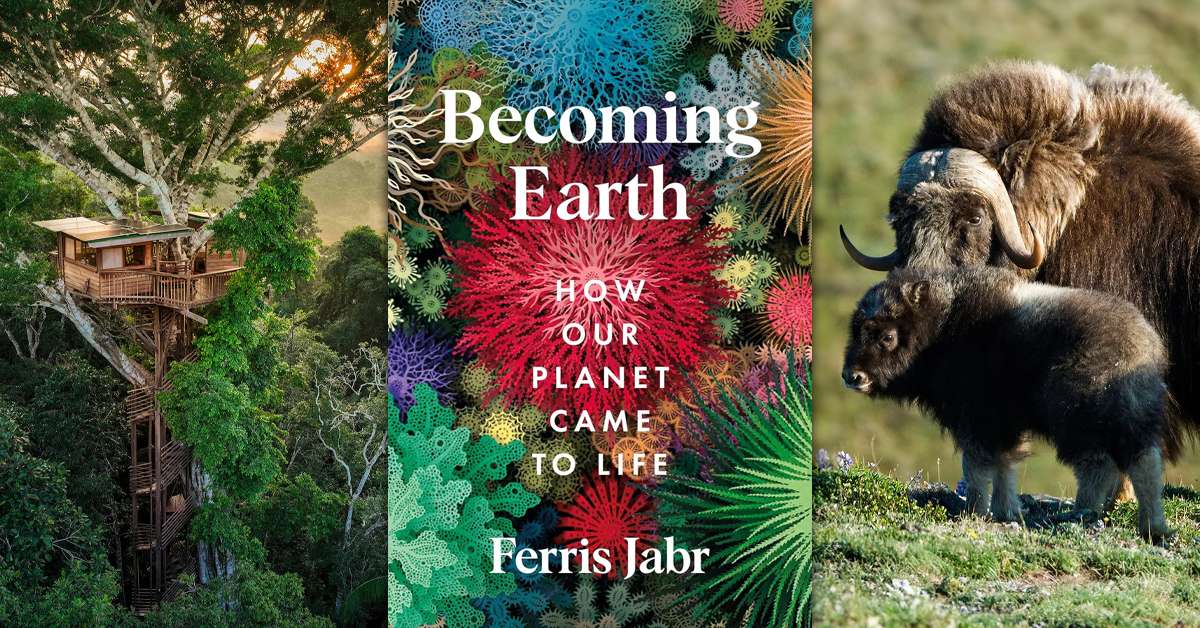
One of humanity’s oldest beliefs is that our world is alive. Though once ridiculed by some scientists, the idea of Earth as a vast, interconnected living system has gained acceptance in recent decades. We, and all living things, are more than inhabitants of Earth—we are Earth, an outgrowth of its structure and an engine of its evolution. Acclaimed science writer Ferris Jabr reveals a radical new vision of Earth where lush forests spew water, pollen, and bacteria to summon rain; giant animals engineer the very landscapes they roam; microbes chew rock to shape continents; and microscopic plankton, some as glittering as carved jewels, remake the air and sea. Humans are one of the most extreme examples of life transforming Earth. We have altered more layers of the planet in less time than any other species, pushing Earth into a crisis. But we are also uniquely able to understand and protect the planet’s wondrous ecology and self-stabilizing processes. Jabr introduces us to a diverse cast of fascinating people who have devoted themselves to this vital work. Ferris Jabr is a contributing writer for The New York Times Magazine. He has also written for The New Yorker, Harper’s, The Atlantic, National Geographic, and Scientific American. He is the recipient of a Whiting Foundation Creative Nonfiction Grant and fellowships from UC Berkeley and MIT. Jabr lives in Portland, Oregon, with his husband, Ryan, their dog, Jack, and more plants than they can count. Get 15% off the book and your ticket when you buy them together! (see ticket options on the Get Tickets link) Tickets:$46.70 Book + Ticket (15% off each!)$35.00 VIP: Premium seating in the front several rows of the center section$25.00 GENERAL ADMISSION$15.00 DISCOUNT (senior, student, it’s your birthday, just can’t afford the GA price right now) Minors ok when accompanied by a parent or guardianReview our venue FAQ here